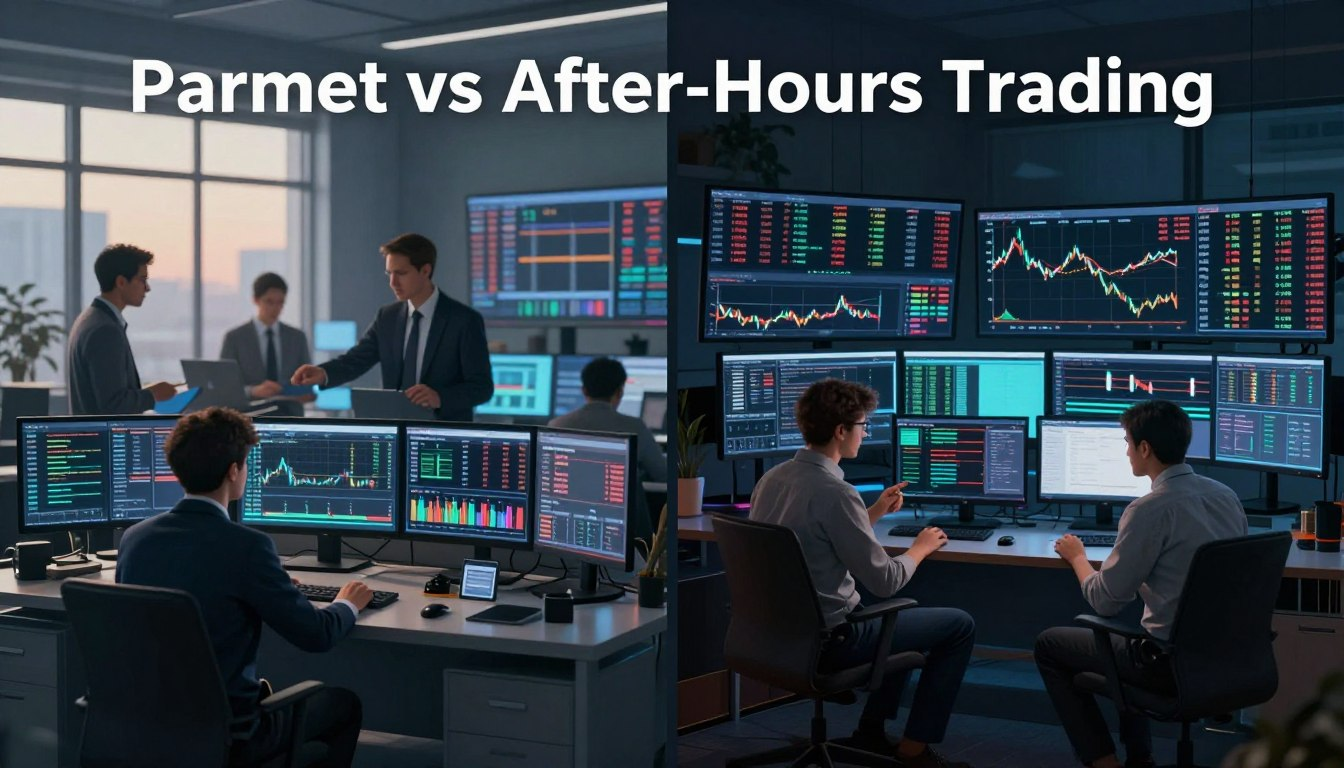
You might feel excited when prices move while most people are asleep. Learning about the dawn and dusk market windows can help you find special opportunities for your portfolio.
These extra windows can offer great growth chances—but they also come with higher risks for your money. You’ll notice that order flow is lower, price moves can look “jumpy,” and bid-ask spreads are often wider than during normal market hours.
Understanding these changes helps you stay cool and protect your hard-earned wealth. This guide explains how premarket and after-hours trading work, why the “rules of the game” feel different, and how to manage the biggest risks so you don’t get surprised by weird fills or sudden gaps.
Key takeaways:
- Liquidity is thinner outside regular hours, which can make prices move sharply on small trades.
- Spreads widen, increasing your “hidden cost” even if commissions are $0.
- Gap risk is real—the next regular session can open far from the extended-hours price.
- Execution is different—some order types may not work or may behave differently.
Understanding Extended-Hours Trading Sessions
Extended-hours trading is a catch-all term for trading that happens outside the main U.S. session. Most people think of the market as “open” from 9:30 a.m. to 4:00 p.m. ET, but many brokers offer access before the open and after the close using electronic trading venues.
These sessions exist for a simple reason: news doesn’t wait. Earnings, guidance, economic data, geopolitical events, analyst notes, and company announcements often hit the tape when the main exchange is closed. Extended hours gives traders a way to respond.
But extended hours is not just “regular trading at a different time.” Market structure changes: fewer participants, fewer quotes, less depth in the order book, and more sensitivity to single trades. That’s why charts can look strange and why people sometimes get unexpected fills.
What Makes Extended-Hours Trading Different from Regular Market Hours
During the regular session, you have broad participation: institutions, market makers, ETFs, retail traders, and algorithmic strategies all interacting. That creates deeper liquidity and tighter spreads in most actively traded stocks. Outside regular hours, participation often shrinks. With fewer buyers and sellers, prices can swing more aggressively and spreads can widen quickly.
In plain terms: in extended hours, the market can feel “thinner”. You might see quotes, but there may not be many shares actually available at those prices. This is a major reason why a trade that seems small can move the price a lot.
Why You Might Want to Trade Outside Standard Hours
There are legitimate reasons to trade premarket or after-hours:
- React quickly to news (earnings, guidance, merger rumors, regulatory headlines).
- Adjust risk after a major event (reduce exposure, hedge, or rebalance).
- Trade around your schedule if you can’t watch markets during the day.
- Capture opportunity in very liquid names when volume spikes during earnings season.
However, these benefits only help you if you also respect the risks: thinner liquidity, wider spreads, and unpredictable execution. If you treat extended hours like the regular session, you can get burned.
The Basic Rules You Need to Know
Before you trade outside the main session, keep these practical rules in mind:
| Rule | Description |
|---|---|
| Availability | Not all stocks trade actively outside regular hours; some may have almost no real liquidity. |
| Liquidity | Lower liquidity often means larger price impact and more partial fills. |
| Order Types | Some brokers restrict order types; limit orders are often preferred or required. |
| Volatility | Expect bigger swings and more frequent gaps compared to normal session behavior. |
If you remember only one thing: limit orders are your seatbelt in extended hours. A market order can fill at a price you didn’t expect because the “best available” price might be far away when the book is thin.[1]
What Is Premarket Trading and When Does It Happen
Premarket trading happens before the regular session opens. It gives traders a way to react to overnight headlines, earnings released early, and price action in overseas markets.
In the premarket, you’ll often see “preview pricing” as the market tries to digest news before the open. That doesn’t mean the open will match the premarket price—just that buyers and sellers are negotiating early.
Premarket Trading Hours and How They Vary by Broker
Premarket access depends on the broker and the venues they route to. Some offer a short premarket window (like 7:00 a.m. to 9:30 a.m. ET), while others offer earlier access. The exact schedule, eligible securities, and rules differ by broker, so always verify your broker’s policy before relying on premarket trading.
How Premarket Stock Trading Actually Works
Premarket trading is mostly electronic. Orders get matched through electronic venues instead of the full “daytime ecosystem” of liquidity. That’s why you might see odd prints or thin order books: there may not be many participants providing competing quotes.
A key concept: price can move dramatically on low volume. A single buyer lifting the offer (or a single seller hitting the bid) can push the last traded price quickly, even if only a few hundred shares traded.
What You Can and Cannot Do in Premarket Sessions
Premarket trading can be helpful, but it comes with limitations:
- Liquidity is lower, increasing slippage risk.
- Order types may be limited (many brokers emphasize or require limit orders).
- Quotes may be less reliable in thin names because depth is limited.
Premarket is often most useful in highly liquid names around major catalysts (earnings, guidance, major macro releases). In thin names with little volume, it can be more like “price discovery in the dark.”
What Is After-Hours Trading and How It Operates

After-hours trading happens after the regular session closes. Many companies release earnings and press releases after the close, so after-hours trading becomes a fast-moving window where the market reacts.
This session often sees sharp moves immediately after the close—especially in widely held large-cap stocks. But activity can fade quickly later in the evening as participation declines.
After-Hours Trading Time Windows Explained
A common after-hours window is roughly 4:00 p.m. to 8:00 p.m. ET, but broker access varies. Some brokers may close access earlier, restrict order types, or limit what securities you can trade.
Who Typically Participates in After-Hours Sessions
After-hours trading often includes professional traders, institutions reacting to announcements, and retail traders who want to reposition quickly. Because fewer participants are active than during the day, the market can be less “stable” and spreads can widen.
Common Reasons Traders Use After-Hours Markets
Traders use after-hours sessions to:
- React to earnings and guidance.
- Adjust positions and reduce overnight risk.
- Take advantage of price swings created by late-breaking news.
But after-hours trading is also where people get surprised. If you chase a move in a thin market, you can pay a wide spread and then watch price snap back when liquidity returns.
Premarket vs After-Hours Trading: Direct Comparison

Premarket and after-hours are both “extended hours,” but they behave differently because they sit on different sides of the regular session and react to different kinds of information flow.
Time Window Differences Between the Two Sessions
Premarket occurs before the open and often reacts to overnight news and international markets. After-hours occurs after the close and often reacts to earnings, guidance, and announcements released at the end of the day.
Which Session Offers Better Opportunities for Your Strategy
There is no “best” session for everyone. Premarket can be better for people who trade the open or want early signals before the day begins. After-hours can be better for people who trade earnings releases or want to adjust positions after major news.
But in both sessions, your edge should be risk control. If you’re trading extended hours, you’re entering a less forgiving environment.
Volume Patterns: How They Differ Throughout Extended Hours
Premarket volume is often lower early and increases closer to the open, especially in high-profile tickers. After-hours volume is often strongest right after 4:00 p.m. ET (especially around earnings) and can fade later as fewer traders remain active.
How Liquidity Changes During Premarket and After-Hours Trading

Liquidity is your ability to buy or sell without moving the price too much. In the regular session, liquidity is typically deeper because more participants are active. Outside regular hours, liquidity can drop dramatically, and that changes everything about execution quality.
Why Liquidity Drops Dramatically Outside Regular Hours
Liquidity drops because fewer buyers and sellers participate. That can cause:
- Wider bid-ask spreads
- Less depth (fewer shares available at each price)
- More slippage (fills at worse prices than expected)
- Higher sensitivity to single orders
Fewer Market Participants Mean Less Liquidity
During the day, institutions, market makers, ETFs, and retail traders provide a steady stream of quotes and orders. Outside regular hours, many of these participants reduce activity. With fewer orders, the market can be “gappy” and less stable.
Institutional vs Retail Trader Presence
Institutional participants may be active around events like earnings, but overall participation is still thinner. Retail traders often make up a larger share of activity in some extended windows, but retail alone usually can’t replicate the liquidity depth of the main session.
Premarket Trading Volume: What to Expect
Premarket volume tends to:
- Increase near 9:30 a.m. ET
- Spike around earnings or major news
- Remain far lower than regular-session volume in most tickers
After-Hours Trading Volume: Typical Patterns and Trends
After-hours volume often:
- Spikes immediately after 4:00 p.m. ET (especially on earnings days)
- Declines later in the session as participants leave
This is why many experienced traders prefer the “busier” parts of extended hours (early after-hours or near the open) rather than the quiet middle where liquidity can be extremely thin.
Bid-Ask Spreads: How Much Wider They Get

The bid-ask spread is one of the biggest differences between regular and extended hours. In a deep market, spreads are often tight because many participants compete to buy and sell. In a thin market, spreads widen because fewer participants are willing to quote aggressively.
Understanding Why Spreads Widen During Extended Hours
Spreads widen because:
- There are fewer competing quotes.
- Market makers and liquidity providers take on more risk in a thin market.
- News shocks can arrive suddenly, increasing uncertainty.
A stock might have a $0.02 spread during the day and a $0.30 spread during extended hours. That extra spread is a real cost, especially if you trade frequently or trade smaller moves.
The Real Cost Impact on Your Trades
Think of the spread as a “toll.” When spreads widen, your entry and exit get more expensive, which can destroy profitability. This matters even for long-term investors if you’re placing a trade during extended hours without realizing the spread is unusually wide.
When Wide Spreads Can Kill Your Profits
Wide spreads can overwhelm small gains—especially for short-term traders or people chasing a headline move. That’s why extended-hours trading is often described as a place where limit orders are mandatory for safety.[1]
Risks of After-Hours Trading and Premarket Sessions
Extended hours can create opportunity—but it also concentrates risk. The most common risks include volatility, gap moves, execution uncertainty, and information asymmetry.
Price Volatility and Gap Risks You Face
When liquidity is low, prices can move dramatically. That can create major gains—but also major losses if you enter at a bad price or if a move reverses when the regular session opens.
How Prices Can Move Dramatically on Low Volume
In extended hours, even a small trade can print far from the prior price if it sweeps the available liquidity. That’s why you might see sudden “spikes” or “drops” that would look unusual during regular hours.
Gap Risk Between Sessions
Gap risk occurs when a stock opens the next regular session at a price far from the previous close or far from the last extended-hours trade. If you hold overnight after an extended-hours move, you must accept that the open can be very different.
Order Execution Risks and Limitations
Execution risk is one of the most underestimated hazards. Your order might not fill, might fill partially, or might fill at a price that looks unfair compared to what you saw on the screen.
Why Your Orders May Not Fill as Expected
Because depth is thin, there may not be enough shares available at your chosen price. You might get a partial fill and then watch the market move away, leaving the rest unfilled. This is common in extended hours.
Limited Order Types Available to You
Some brokers limit what orders you can use in extended hours. Stop orders may not trigger as you expect, and market orders can be risky due to thin liquidity. Many investor education materials emphasize the risks and prefer the use of limit orders in extended hours.[2]
Information Asymmetry and Market Manipulation Concerns
Another concern is information flow. News can spread unevenly, and professional traders may react faster than retail traders. In low liquidity environments, aggressive orders can also move price more easily. That doesn’t mean “everyone is manipulating,” but it does mean extended hours can be less forgiving if you chase moves without a plan.
Premarket Trading Strategies for Smart Traders
Good premarket trading strategies aren’t about being early—they’re about being prepared. Premarket rewards discipline: focusing on liquid tickers, trading around clear catalysts, and managing risk with precise order placement.
Gap Trading and Overnight News Reactions
Gap trading involves reacting to price moves caused by overnight news. The key is to avoid “blind chasing.” A gap can continue, but it can also reverse hard once regular-session liquidity arrives.
Key considerations for gap trading:
- Track the catalyst (earnings, guidance, macro data, industry news).
- Watch volume (gaps with no volume can be unreliable).
- Use limit orders and smaller position sizes.
Earnings Announcement Plays in Premarket Hours
Earnings can dominate premarket trading. If you trade earnings, understand that volatility can be extreme and spreads can widen rapidly. Many “earnings pops” retrace, and many “earnings drops” bounce—especially when the broader market opens and liquidity floods in.
Setting Up Your Watchlist for Premarket Opportunities
A strong watchlist makes premarket calmer. Instead of scanning thousands of tickers, focus on a shortlist:
- Stocks with earnings releases (pre-open or after close).
- Stocks with major news catalysts (upgrades/downgrades, FDA decisions, legal rulings).
- Highly liquid names where spreads are less likely to explode.
| Strategy | Description | Key Considerations |
|---|---|---|
| Gap Trading | Reacting to price gaps caused by overnight news. | Monitor catalyst + volume, use limit orders, define risk. |
| Earnings Plays | Trading reactions to earnings announcements. | Expect volatility, avoid chasing, size smaller than normal. |
| Watchlist Focus | Tracking only catalyst-driven, liquid tickers. | Reduces noise and improves execution quality. |
After-Hours Trading Tips to Protect Yourself
After-hours trading can be useful, but the main goal should be protecting your capital. One sloppy order can undo weeks of careful investing if you get a bad fill in a thin market.
Always Use Limit Orders, Never Market Orders
Limit orders are essential in extended hours. A limit order lets you control your worst acceptable price. A market order can fill at an extreme price if liquidity is thin.[1]
How to Monitor Earnings Announcements and News Effectively
After-hours moves are often earnings-driven. If you trade after-hours, have a system:
- Read the press release (not just the headline).
Starting Small: Your Risk Management Approach
If you’re newer to extended hours, start with smaller position sizes than you’d use in regular hours. This reduces the damage from wide spreads, slippage, and gap reversals.
Best Times Within After-Hours for Better Liquidity
Liquidity often clusters around key moments: immediately after the close (especially during earnings season) and sometimes around major news events. Later in the session, liquidity can fade and spreads can widen dramatically.
| Time | Liquidity Level | Reason |
|---|---|---|
| 4:00 PM – 5:00 PM ET | Higher | Immediate post-close activity and earnings reactions |
| Near the open | Higher | Activity increases as regular session approaches |
| Quiet mid-evening | Lower | Fewer participants, wider spreads, less depth |
Choosing the Right Premarket and After-Hours Trading Platforms
Trading outside regular hours depends heavily on your broker’s access and rules. Some brokers offer robust extended-hours tools; others offer limited windows or restrict order types. Before you rely on extended hours, confirm:
- Which extended-hours windows you can access (premarket, after-hours, overnight if available).
- Which order types are allowed (limit-only policies are common).
- Whether you receive real-time data and clear order-status updates.
Also remember: even if commission is $0, execution quality matters. A single wide spread can cost more than a traditional commission.
Conclusion
Understanding premarket vs after-hours trading is about understanding market structure. Outside normal hours, liquidity drops, spreads widen, and volatility increases. That’s why extended hours can feel “weird” compared to regular trading.
If you choose to trade these sessions, keep your process simple and defensive: trade liquid names, use limit orders, size smaller, and don’t chase moves when depth is thin. Extended hours can be useful—but only if you respect that it’s a different environment with different rules.[1][2]
FAQ
Q: What is the primary difference when comparing premarket vs after-hours trading?
A: Premarket trading happens before the open and often reflects overnight news and global market moves. After-hours trading happens after the close and often reflects earnings and late announcements. Both sessions usually have thinner liquidity and wider spreads than the main session.[1]
Q: Why is after-hours trading volume usually lower than during the regular session?
A: Fewer participants are active outside normal hours, which reduces liquidity and depth. That makes the market more sensitive to trades and can increase volatility and spreads.[1]
Q: What are the biggest risks of after-hours trading I should be aware of?
A: The biggest risks are wider spreads, higher volatility, partial fills, and unexpected execution prices. Some order types may also be restricted outside regular hours, which can reduce your ability to manage risk.[2]
Q: What are some essential after-hours trading tips to keep my portfolio safe?
A: Use limit orders, start small, avoid thin tickers, and don’t assume an extended-hours price will hold into the next day. Always consider spread width and depth before placing a trade.[1]