Last updated: May 2026
Stocks, bonds, funds, and trading venues can have several different codes attached to them. A ticker symbol may be the code you see most often, but it is not the only identifier used in financial markets.
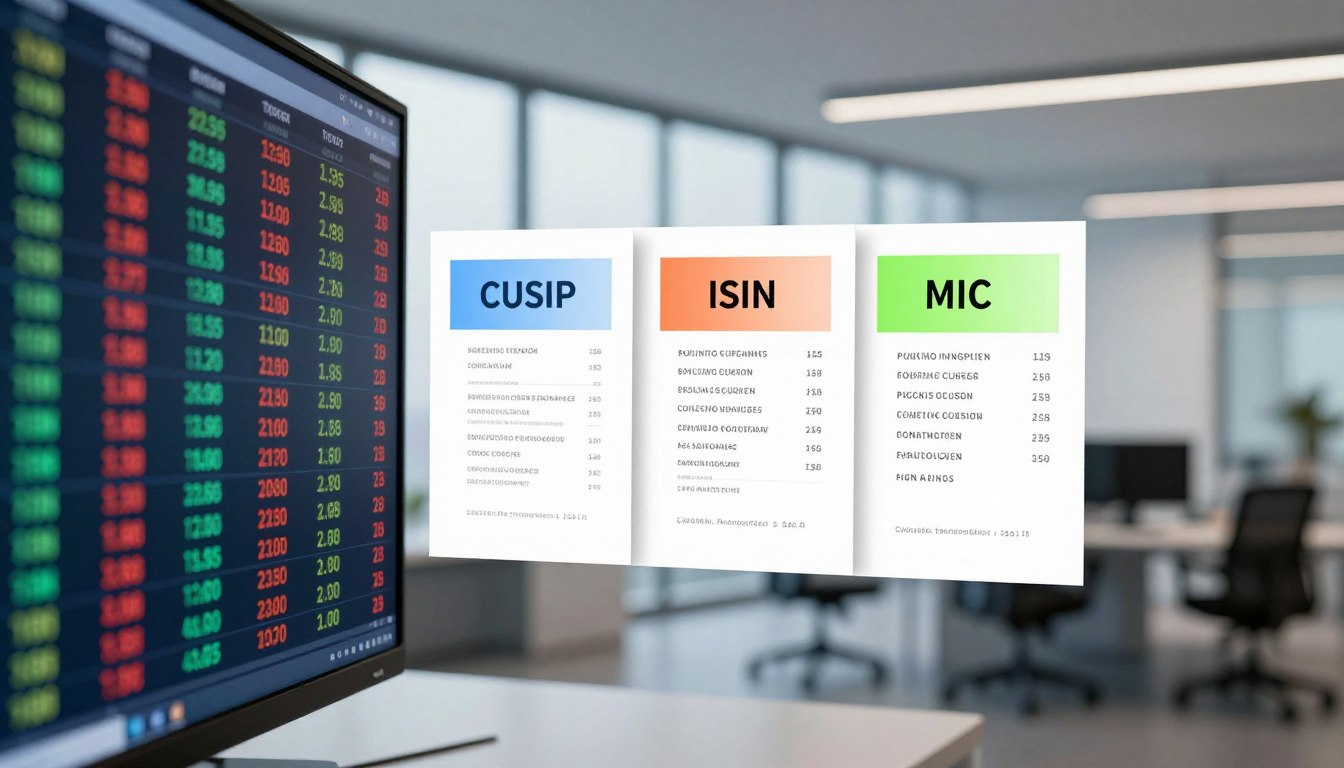
Other codes, such as CUSIP, ISIN, and MIC, help brokers, exchanges, clearing systems, regulators, and investors identify securities and trading venues more accurately. Understanding the difference can help you avoid confusion when reading statements, researching corporate actions, or tracking securities across markets.
Quick Answer: Ticker vs CUSIP vs ISIN vs MIC
A ticker symbol identifies a security for trading on a specific exchange or platform. A CUSIP identifies many North American securities. An ISIN is a global security identifier. A MIC identifies a trading venue or market, not the security itself.
| Code | What It Identifies | Typical Use | Example Type |
|---|---|---|---|
| Ticker | A traded security on a specific venue | Quotes, trading, watchlists, news | AAPL |
| CUSIP | A North American security | Broker records, statements, settlement, tax forms | 9-character identifier |
| ISIN | A security globally | International tracking and cross-border securities identification | 12-character identifier |
| MIC | A trading venue or market | Identifying where a trade happened | XNAS, XNYS |
Why These Financial Codes Matter
Financial markets rely on clear identification. A company may have a common name, several share classes, bonds, preferred shares, depositary receipts, or listings on more than one exchange. A simple company name is not always enough to identify the exact security.
These codes reduce confusion by giving brokers, exchanges, clearing systems, and reporting tools a more precise way to identify securities and trading venues.
They are especially useful when:
- A ticker changes after a rebrand, merger, or spin-off.
- A company has more than one share class.
- A security trades in more than one country.
- You are checking a brokerage statement or tax form.
- You need to confirm where a trade was executed.
- A corporate action changes how a security appears in your account.
If you are tracking a stock after its symbol changed, these identifiers can help you avoid mixing up the old and new ticker. For more detail, see How to Track a Stock After a Ticker Change.
What Is a Ticker Symbol?
A ticker symbol is the short code used to identify a security on an exchange or trading platform. It is the code most investors see in brokerage apps, price charts, financial news, and watchlists.
For example, a company listed on Nasdaq or the NYSE has a ticker that helps investors quickly search for quotes and place trades. Tickers are useful, but they are not always permanent or globally unique.
What ticker symbols are used for
- Looking up stock prices
- Placing trades
- Building watchlists
- Reading financial news
- Following charts and market data
Limitations of ticker symbols
Ticker symbols can change after a corporate action, name change, merger, spin-off, or exchange transfer. In some cases, a ticker that once belonged to one company may later be reused by another.
This is why a ticker alone is not always enough for long-term recordkeeping. If the ticker changes, you may need to confirm the company name, CUSIP, ISIN, CIK, or other official identifiers.
For a full explanation of symbol changes, see Why Do Stock Tickers Change?.
What Is a CUSIP?
A CUSIP is a security identifier commonly used for U.S. and Canadian securities. It is often found on brokerage statements, bond records, confirmations, tax documents, and corporate action notices.
A CUSIP is commonly described as a nine-character identifier. It helps distinguish specific securities, including different securities issued by the same company or government entity.
What CUSIP codes help identify
- Stocks
- Bonds
- Municipal securities
- U.S. Treasury securities
- Some funds and other financial instruments
Why CUSIP matters to individual investors
You may see a CUSIP on your brokerage statement, tax form, trade confirmation, or bond record. It can help verify that the security listed in your account is the exact one you intended to hold.
CUSIP can be especially useful when a ticker changes, when a company has multiple securities, or when you are checking cost basis and tax records. If you need help reading those details in your account records, see How to Read a Monthly Brokerage Statement.
What Is an ISIN?
An ISIN, or International Securities Identification Number, is a global identifier for securities. It is commonly used in international markets and cross-border trading.
An ISIN is usually 12 characters long. It includes a country code, a national security identifier, and a check digit. For North American securities, the ISIN may incorporate the CUSIP as part of the structure.
Why ISIN is useful
ISIN helps identify securities across countries, brokers, custodians, and data platforms. This is useful when a company trades in more than one market or when different platforms use different local ticker formats.
For investors who hold international securities, the ISIN can be more reliable than a ticker because ticker formats vary between markets.
What Is a MIC?
A MIC, or Market Identifier Code, identifies a trading venue or market. Unlike ticker, CUSIP, and ISIN, a MIC does not identify the security itself. It identifies where trading happens.
For example, a MIC can identify a stock exchange, trading platform, or market segment. This helps with trade reporting, market data, routing, and settlement records.
Operating MIC vs. segment MIC
MIC codes can be used at different levels. An operating MIC may identify the main market operator, while a segment MIC may identify a specific market segment or trading platform under that operator.
This distinction matters more for institutions, market data systems, and regulatory reporting than for everyday investors, but it helps explain why trade records sometimes include venue-level codes.
Key Differences Between Ticker, CUSIP, ISIN, and MIC
| Code | Identifies | Scope | Can It Change? | Best Use |
|---|---|---|---|---|
| Ticker | Trading symbol for a security | Exchange or platform specific | Yes, often after corporate actions | Quotes, trading, charts, watchlists |
| CUSIP | Security identifier | Mostly North America | Can change in some reorganizations | Statements, settlement, tax records |
| ISIN | Global security identifier | International | Usually stable, but not impossible to change | Cross-border security tracking |
| MIC | Trading venue identifier | Global market venues | Can change if venue data changes | Identifying where a trade occurred |
What Each Code Actually Identifies
The easiest way to avoid confusion is to separate security identifiers from market identifiers.
Security-level identifiers
Ticker symbols, CUSIPs, and ISINs are connected to securities, but they work differently.
- Ticker — A trading label used on a specific exchange or platform.
- CUSIP — A North American identifier for securities.
- ISIN — A global identifier for securities.
Market-level identifiers
MIC codes identify trading venues, not securities. They help answer a different question: where did the trade happen?
- MIC — Identifies a market, exchange, or trading venue.
When to Use Each Code
Use ticker symbols for quick lookups
Ticker symbols are best for checking prices, placing trades, reading market news, and building watchlists. They are fast and easy to use, but they should not be your only long-term identifier.
Use CUSIP for statements and tax records
CUSIP identifiers are useful when reading brokerage statements, trade confirmations, bond records, and tax forms. If the same company has multiple securities, the CUSIP helps distinguish the exact security.
Use ISIN for international securities
ISIN is especially useful when tracking securities across countries or data vendors. It can help prevent confusion when the same company has different tickers in different markets.
Use MIC to identify trading venues
MIC codes are useful for trade reporting, execution records, market data, and understanding where a transaction occurred.
How These Codes Help During Corporate Actions
Corporate actions can make account records confusing. A ticker may change, a new security may be issued, or your share count may change. In those situations, security identifiers can help you confirm what happened.
Identifiers are useful during:
- Ticker changes
- Stock splits and reverse splits
- Mergers
- Spin-offs
- Delistings
- Exchange transfers
If a ticker change happens alongside a stock split, the account update can look confusing. For a plain-English comparison, see Ticker Change vs Stock Split.
If new shares appear because of a spin-off, the new company may receive its own ticker and security identifiers. For more detail, see Spin-Offs 101: How New Tickers Are Created.
How to Find and Verify These Codes
When accuracy matters, start with sources that are closest to the security you actually hold. Your broker’s records and official company documents are usually better than random search results.
Brokerage statements and confirmations
Your broker statement, trade confirmation, or corporate action notice may show the ticker, CUSIP, ISIN, or other identifiers. This is often the most practical place for individual investors to start.
Company filings
For U.S. public companies, SEC EDGAR can help you find official filings. Some filings include CUSIP, ticker, CIK, share class, or corporate action details.
Exchange websites
Exchange websites can help confirm ticker symbols, listing venue, symbol changes, and trading venue information.
Official identifier resources
CUSIP Global Services, ANNA, ISO, and other official or standards-related sources can help verify identifier structures and governance.
Cross-check before relying on one code
Do not rely on only one search result. When possible, compare the company name, ticker, CUSIP, ISIN, exchange, and broker record. This is especially important after a ticker change, merger, spin-off, or delisting.
Common Mistakes to Avoid
Assuming a ticker is permanent
Tickers can change and may be reused later. For long-term tracking, keep additional identifiers when available.
Confusing a market code with a security code
A MIC identifies a trading venue, not the stock or bond itself. Do not use a MIC as if it were a security identifier.
Using old data after a corporate action
After a merger, spin-off, or split, old data platforms may lag. Verify the current security details through official records and your broker.
Ignoring share classes
Some companies have multiple share classes with different tickers or identifiers. Always confirm the exact class you hold.
Conclusion
Ticker, CUSIP, ISIN, and MIC codes all help organize financial markets, but they do different jobs. A ticker is the trading symbol most investors use every day. A CUSIP identifies many North American securities. An ISIN identifies securities globally. A MIC identifies the trading venue where activity occurs.
The main lesson is simple: use the ticker for quick lookups, but use official identifiers and broker records when accuracy matters. This is especially important after corporate actions, international trades, or any account change that makes your holdings look unfamiliar.
For the most accurate details about a specific security or trade, use your broker’s records, official filings, exchange resources, and recognized identifier sources as primary references.
Sources and Further Reading
- CUSIP Global Services — Official administrator resource for CUSIP identifiers.
- Association of National Numbering Agencies — Global association related to ISIN governance and National Numbering Agencies.
- ISO 10383 Market Identifier Codes — ISO standard page for MIC codes.
- ISO 20022: Market Identifier Codes — Explains MICs and links to MIC-related resources.
- SEC EDGAR — Search official company filings and corporate action-related disclosures.
- FINRA: Corporate Actions by Public Companies — Explains corporate actions and how they can affect investor records.
FAQ
What is the main difference between a ticker, CUSIP, ISIN, and MIC?
A ticker is a trading symbol. A CUSIP identifies many North American securities. An ISIN identifies securities globally. A MIC identifies a trading venue or market, not the security itself.
Is a ticker symbol the same as a CUSIP?
No. A ticker is the symbol used for trading and price quotes. A CUSIP is a more formal security identifier used in records, settlement, statements, and some tax documents.
Is ISIN better than a ticker?
It depends on the use. A ticker is easier for quick price checks and trading. An ISIN is better for identifying a security across countries and data systems.
What does a MIC code identify?
A MIC identifies a market or trading venue. It helps show where a trade took place. It does not identify the stock or bond itself.
Can ticker symbols change?
Yes. Ticker symbols can change after a rebrand, merger, spin-off, exchange transfer, or other corporate action. That is why long-term records should include more than just the ticker.
Can CUSIP or ISIN change?
They are usually more stable than tickers, but they can change when a new security is issued or a major reorganization occurs. Always verify current identifiers through official sources and your broker.
Where can I find the CUSIP or ISIN for a security I own?
Start with your brokerage statement, trade confirmation, corporate action notice, or official company filings. Your broker may also provide identifier details in downloadable account documents.
Which code should I use after a ticker change?
Use the new ticker for quotes and trading, but confirm the company and security using CUSIP, ISIN, CIK, official filings, and your broker’s records when accuracy matters.